



Amazon Rufus vs. Traditional A9: Complete Ranking Factor Comparison Matrix

Tuesday, February 03, 2026

Amazon/Amazon AI Rufus/Amazon Rufus vs. Traditional A9: Complete Ranking Factor Comparison Matrix
Rufus vs. Traditional A9: Complete Ranking Factor Comparison Matrix

Rufus vs. Traditional A9: Complete Ranking Factor Comparison Matrix

Quick Answer (40 words) Traditional A9 ranks products using keyword matching, sales velocity, and CTR. Rufus AI uses semantic understanding, Subjective Product Need classification, and conversational context to recommend products based on buyer intent rather than exact keyword presence.

The Fundamental Paradigm Shift

Amazon's search algorithm has undergone its most significant transformation in over a decade. While Amazon's Rufus AI assistant now handles 13.7% of total Amazon searches as of October 2024, what most sellers miss is that the underlying ranking logic has fundamentally changed.

The traditional A9 algorithm (and its successor A10) operated on a binary logic: either your listing contains the keyword or it doesn't. Rufus operates on probability distributions, semantic similarity scores, and contextual relevance matrices. This isn't an incremental update. It's a different category of search technology entirely.

Critical Insight: According to research published at the 2025 ACM Web Search and Data Mining conference by Amazon scientists Dammu, Alonso, and Poblete, Rufus evaluates products across five "Subjective Product Needs" dimensions using a trained classifier. The system processes an average of 400 customer reviews per shopping session, saving users approximately 2.67 hours of manual reading time.

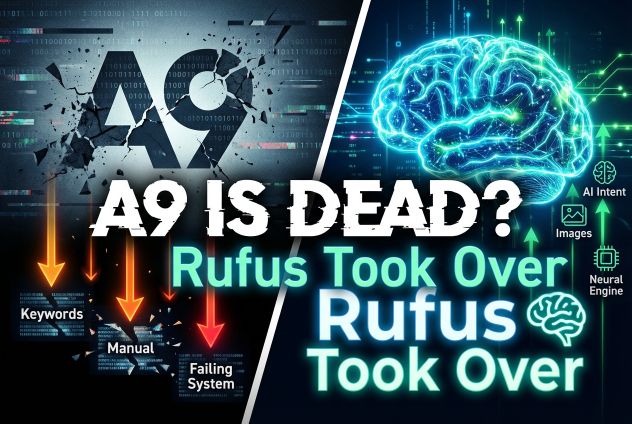
Traditional A9 asked: "Does this listing contain the search term?" Rufus asks: "Does this product solve the customer's underlying problem?" The difference is everything.

Complete Ranking Factor Comparison Matrix

Ranking FactorTraditional A9/A10Rufus AIImpact Shift
Keyword Matching Exact match required Semantic equivalenceSynonyms now rank equally
Sales Velocity Primary factor Still importantRemains core signal
Click-Through Rate Critical metric Less direct impactAI bypasses search results page
Conversion Rate Heavily weighted Still weightedStable importance
Price Competitiveness Indirect factor Explicit evaluationAI contextualizes pricing
Review Sentiment Aggregate rating Semantic analysisContent matters more than stars
Subjective Properties Not evaluated Weighted at 0.35NEW: "sturdy", "spacious"
Use Case Context Ignored Core ranking factorNEW: Event/activity relevance
Target Audience Fit Not considered Weighted at 0.35NEW: "for kids", "for beginners"
Q&A Content Quality Not indexed Indexed and rankedNEW: RAG retrieval source
A+ Content Value Indirect (conversion) Direct NLP analysisContent comprehension matters
External Authority Not factored Citations from webNEW: 3rd party validation
Vagueness Score Doesn't exist Algorithmic (>0.4 = clarification)NEW: Conversational engagement
Account History No personalization Purchase/browse historyNEW: Individual recommendations
Upper Funnel Position Category relevance Weighted in vagueness formulaCalculated differently

Traditional A9/A10 Ranking Factors Explained

The A9 algorithm (and its incremental update A10) operated on relatively straightforward principles that dominated Amazon search from 2003 through early 2024. Understanding these factors remains important because they still influence non-Rufus search paths.

Core A9/A10 Ranking Factors

1. Keyword Relevance

A9 performed exact string matching against product titles, bullet points, descriptions, and backend search terms. If a customer searched for "wireless bluetooth headphones" and your listing contained those exact words in that exact order, you ranked higher than a listing that only had "bluetooth wireless headphones."

2. Sales Velocity (Recent Performance)

Products with higher sales velocity in recent time periods (7-day, 30-day rolling windows) ranked better. This created a flywheel effect where top-ranked products generated more sales, which reinforced their ranking position.

3. Conversion Rate (Unit Session Percentage)

The percentage of sessions that resulted in a purchase directly impacted ranking. A product converting at 15% would outrank a product converting at 8%, all else being equal.

4. Click-Through Rate

The ratio of impressions to clicks signaled relevance. Products that generated clicks from search impressions received ranking boosts. Main image quality and title optimization drove this metric.

5. Price (Indirectly)

A9 didn't explicitly rank by price, but price affected conversion rate and sales velocity. Competitive pricing influenced ranking through its impact on purchase decisions.

6. Review Quantity and Average Rating

Products with more reviews and higher average ratings ranked better, but the algorithm treated this as a simple aggregate. A product with 500 reviews at 4.5 stars outranked one with 50 reviews at 4.8 stars.

The A9 Limitation: This system excelled at matching explicit keywords but failed completely at understanding buyer intent. A search for "laptop for video editing" would surface laptops containing those keywords, but A9 had no mechanism to evaluate whether the laptop actually had sufficient GPU performance, RAM, or color accuracy for professional video work.

Rufus AI Ranking Factors Explained

Rufus fundamentally reimagines product ranking through natural language processing, semantic similarity scoring, and retrieval-augmented generation. According to AWS's machine learning blog, Rufus is powered by 80,000+ AWS Inferentia and Trainium chips running multiple large language models including Anthropic's Claude Sonnet and Amazon's custom-built shopping LLM.

The Subjective Product Needs Framework

Amazon's WSDM 2025 research paper reveals that Rufus classifies every query across five dimensions:

1. Subjective Properties (Weight: Variable)

Attributes that require personal interpretation: "sturdy," "spacious," "comfortable," "luxurious feel," "easy to use." Rufus extracts these from review text using S-BERT (Sentence-BERT) semantic similarity models.

2. Event Relevance (Weight: 0.35 for gifting)

Contextual appropriateness for specific occasions: "Perfect for Christmas," "Ideal for weddings," "Great for back-to-school." The algorithm identifies event mentions in reviews and product descriptions.

3. Activity Context (Weight: Variable)

Use case alignment with specific activities: "for hiking," "for office work," "for outdoor photography." Rufus matches these against review mentions of actual usage scenarios.

4. Goal/Purpose (Weight: Variable)

Outcome-based requirements: "weight loss," "better sleep," "improved productivity." The system evaluates whether reviews confirm the product achieves stated goals.

5. Target Audience (Weight: 0.35 for gifting)

Demographic and user-type fit: "for beginners," "for kids age 3-5," "for seniors," "for professional photographers." This leverages review data about who actually uses the product.

The Vagueness Score Algorithm

One of the most technically sophisticated aspects of Rufus is its vagueness detection system. The mathematical model is:

V = α · (1 - Σ(wi · SPNi)) + β · uf
Where:
• V = vagueness score (0 to 1)
• α and β = weights that sum to 1
• wi = individual weights for SPN presence
• uf = upper funnel score (0-1, where broad queries = 1)

If V > 0.4, Rufus engages in conversational clarification

This means Rufus doesn't just passively rank results. It actively determines when it needs more information and asks follow-up questions to refine recommendations.

Review Ranking via Semantic Similarity

Rufus uses a sigmoid-based review ranking formula:

R = σ(α · Σ(wi · SPNi) + β · sim(D, R))
Where:
• R = review relevance score (0 to 1)
• σ(x) = sigmoid function: 1/(1+e-x)
• sim(D, R) = cosine similarity between user description and review text

This allows Rufus to surface the most contextually relevant reviews even if they don't contain the exact search terms. A review mentioning "survived my toddler's abuse for two years" might rank higher for "durable toys for kids" than a review saying "good quality."

Retrieval-Augmented Generation (RAG)

Unlike A9's static catalog queries, Rufus performs real-time information retrieval from multiple sources:

  • Amazon product catalog (structured data)
  • Customer reviews (unstructured text)
  • Community Q&A content
  • External web sources (NY Times, Good Housekeeping, Vogue product reviews)
  • Individual account purchase and browsing history

This RAG architecture means Rufus can cite external authority to validate product claims. If The New York Times reviewed a product positively, Rufus can incorporate that endorsement into its recommendation logic.

Strategic Implications for Sellers

The shift from A9 to Rufus requires fundamentally different optimization strategies. Our work with 7-figure sellers at Atomic has revealed three critical areas where most brands are still optimizing for the old algorithm.

Implication 1: Keyword Density Is Dead, Semantic Context Is King

Repeating "wireless bluetooth headphones" seven times in your bullets no longer helps. Rufus understands synonyms, related concepts, and contextual meaning. Instead of keyword stuffing, focus on comprehensive problem-solution clarity.

Old approach: "Wireless Bluetooth Headphones with Wireless Bluetooth Connectivity for Wireless Bluetooth Audio"

New approach: "Connect wirelessly to any device via Bluetooth 5.0. Stream high-fidelity audio without cables interfering with your workout. Perfect for running, gym sessions, and outdoor activities where freedom of movement matters."

The second example uses different terminology but provides semantic richness that Rufus can match against queries like "headphones for working out" or "best earbuds for running without wires getting in the way."

Implication 2: Review Content Quality Now Directly Impacts Ranking

Under A9, reviews only mattered as aggregate ratings. Under Rufus, review text content is actively parsed and semantically analyzed. This means:

  • Generic reviews ("Great product!") provide zero ranking value
  • Specific use case reviews ("Used this on my Mt. Kilimanjaro climb, survived extreme weather") provide high value
  • Reviews mentioning subjective properties ("Feels sturdy, much more solid than competitors") strengthen SPN signals
  • Reviews from verified purchases of your target demographic carry extra weight

The implication is that review generation strategies must shift from maximizing quantity to maximizing specific, contextual, use-case-driven content.

Implication 3: A+ Content Is No Longer Optional

Rufus actively indexes and analyzes A+ content using natural language processing. Comparison charts, lifestyle images with descriptive text, and comprehensive feature explanations all feed into Rufus's understanding of your product.

Sellers treating A+ content as a "nice to have" are missing a major ranking signal. Rufus specifically looks for:

  • Comparison tables (which products you position against)
  • Use case scenarios with visual + text explanation
  • Feature benefits articulated in natural language
  • FAQ sections that address common objections

Implication 4: External Authority Signals Matter

This is perhaps the most underutilized opportunity. Rufus can pull external web content into its recommendation logic. If your product has been reviewed by credible third-party sources, you want Rufus to know about it.

According to a recent LinkedIn observation by Leo Sgovio, Amazon has introduced a "Researched by AI" section that cites external publications like GamesRadar+ at the top of mobile search results. This suggests Rufus is prioritizing off-site editorial authority over on-page keyword optimization.

Frequently Asked Questions

Does traditional Amazon SEO still matter with Rufus AI?
Yes. Foundational optimization (keyword relevance, sales velocity, reviews) still matters because not all traffic flows through Rufus. However, semantic clarity now outweighs keyword density.
How does Rufus handle keyword synonyms differently than A9?
Rufus uses S-BERT semantic similarity models to understand meaning relationships. "Running shoes" and "athletic footwear for jogging" are semantically equivalent, whereas A9 treated them as completely different queries.
What is a vagueness score and why does it matter?
Vagueness score (0-1 scale) measures query specificity. Scores above 0.4 trigger conversational clarification. Products optimized for specific use cases rank better in follow-up responses after Rufus gathers context.
Can sellers optimize specifically for Rufus without hurting traditional search ranking?
Absolutely. Semantic optimization (clear benefits, use cases, subjective properties) improves both Rufus AI ranking and human conversion rates. The strategies are complementary, not conflicting.
How important are customer reviews for Rufus ranking?
Critical. Rufus processes an average of 400 reviews per session using semantic analysis. Review content quality (specific use cases, subjective properties) now directly impacts ranking, not just aggregate ratings.
Does Rufus consider external product reviews from websites?
Yes. Rufus uses retrieval-augmented generation (RAG) to pull content from external sources including NY Times, Good Housekeeping, and Vogue. Third-party editorial validation strengthens recommendation confidence.
What are Subjective Product Needs and how are they weighted?
SPNs are five dimensions Rufus evaluates: subjective properties, event relevance, activity context, goals, and target audience. For gifting queries, event and audience factors are weighted at 0.35 each.
Will Rufus completely replace traditional Amazon search?
Not immediately. As of October 2024, Rufus handles 13.7% of searches. Amazon projects 35-40% by end of 2025. Both systems will coexist, but Rufus growth is accelerating rapidly.
How does Rufus personalization work compared to A9?
A9 offered minimal personalization. Rufus uses account purchase history, browsing behavior, and prior Rufus conversations to tailor recommendations. Two customers asking identical questions receive different suggestions based on their history.
What's the biggest mistake sellers make when optimizing for Rufus?
Continuing to optimize for keyword density instead of semantic clarity. Rufus doesn't count keyword repetitions; it evaluates whether your listing comprehensively addresses the customer's underlying problem across multiple contexts.

Key Takeaways

  • Traditional A9 used exact keyword matching; Rufus uses semantic similarity and natural language understanding
  • Rufus processes an average of 400 reviews per session using S-BERT models to extract contextual meaning
  • Five Subjective Product Needs (subjective properties, events, activities, goals, audience) now drive ranking
  • Vagueness scores above 0.4 trigger conversational clarification, making specificity essential
  • Review content quality (not just quantity) directly impacts Rufus ranking through semantic analysis
  • External authority signals from credible publications now influence Amazon recommendations
  • A+ content is actively indexed and analyzed by Rufus's NLP systems
  • Keyword density optimization is obsolete; semantic context clarity is critical
  • As of October 2024, Rufus handles 13.7% of searches with projected growth to 35-40% by end of 2025
  • Both ranking systems coexist, but optimization strategies must prioritize semantic clarity over keyword repetition

References

  1. Dammu, P.P.S., Alonso, O., & Poblete, B. (2025). A shopping agent for addressing subjective product needs. Proceedings of the Eighteenth ACM International Conference on Web Search and Data Mining (WSDM '25), March 10-14, 2025, Hannover, Germany. ACM. https://dl.acm.org/doi/10.1145/3701551.3704124
  2. Amazon. (2024). Amazon announces Rufus, a new generative AI-powered conversational shopping experience. About Amazon. https://www.aboutamazon.com/news/retail/amazon-rufus
  3. Amazon. (2025). Amazon's next-gen AI assistant for shopping is now even smarter, more capable, and more helpful. About Amazon. https://www.aboutamazon.com/news/retail/amazon-rufus-ai-assistant-personalized-shopping-features
  4. Amazon Web Services. (2024). How Rufus scales conversational shopping to millions. AWS Machine Learning Blog. https://aws.amazon.com/blogs/machine-learning/
  5. Sgovio, L. (2025). Amazon quietly launched "Researched by AI" feature: What it means for sellers. LinkedIn. https://www.linkedin.com/
Disclaimer: This content is based on publicly available research, Amazon's official documentation, and observational analysis of platform behavior. Amazon's algorithms are proprietary and subject to change. The strategies discussed represent informed analysis of current system architecture as of February 2026.

Find out if your Brand is invisible to Amazons Rufus AI discovery tool and how to close the Gaps